Best connectivity for UK restaurants.
Card payments that work through service rush, guest WiFi that handles every cover, POS uptime that doesn't fail at 7.30pm Friday, phone systems that capture every booking. Restaurant connectivity that actually fits the business.


Fibre to the building, managed to the desk.
Full fibre (FTTP) runs fibre all the way into your premises over the Openreach or CityFibre network. Telexico supplies the managed router, checks what each carrier can deliver at your postcode and keeps it monitored.
Need the same speed up as down, guaranteed? That is a dedicated leased line, on the next page of the range.
What we hear every week.
The frustrations behind why businesses search for best connectivity for uk restaurants in the first place. If any of these feel familiar, the fix is straightforward.
Card terminals offline during service
Card terminal goes offline at 7.30pm. Customer waiting, staff embarrassed, sale lost. Card payment failure during peak service is the most damaging connectivity failure in restaurants.
Guest WiFi 1-star in reviews
Diners complaining about WiFi in reviews. Hard to argue with; even harder to fix without proper site survey and managed WiFi.
POS dropping mid-service
Connection-dependent POS systems hanging when broadband stutters — orders lost, kitchen confusion, service quality drops.
Bookings going to voicemail
Reception phone competing with service rush — booking calls unanswered, customers booking elsewhere.
Restaurant connectivity, properly designed
Restaurant connectivity isn't an office network with table layout. It's specifically: business broadband sized for peak load (kitchen, POS, card terminals, guest WiFi, phone, music streaming, dashboards); 4G/5G failover so card payments and POS keep working through outages; mesh WiFi designed for the venue (front of house density, back of house coverage, segregated guest network); cloud VoIP with AI receptionist for booking calls; QoS configured so guest streaming doesn't compete with payments. We design and install all of it as one integrated setup.
Built to stay up.
- Full fibre, SoGEA or a leased line, chosen from the survey
- Automatic 4G/5G failover available on every business set-up
- Monitored from the Telexico portal, supported by a named UK engineer
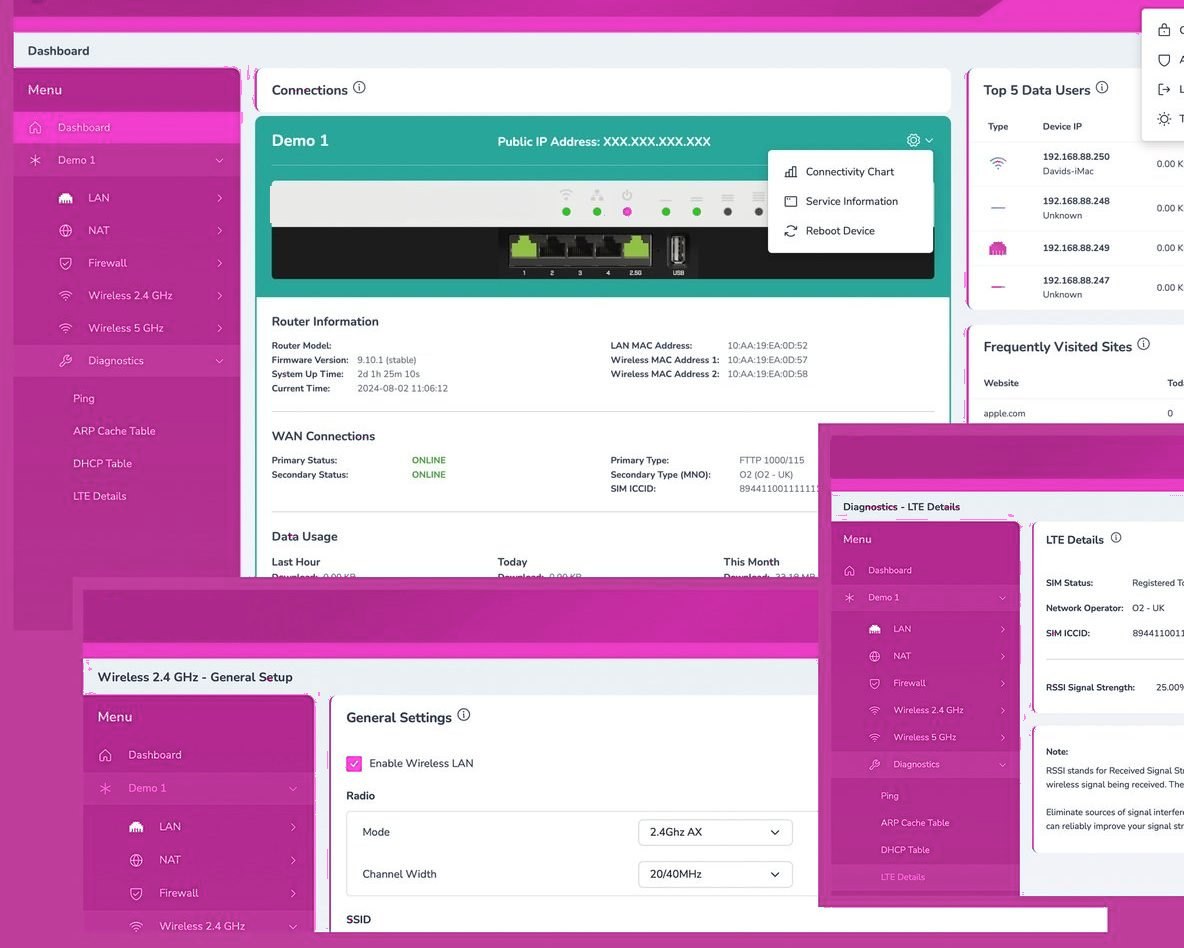
The Telexico approach to best connectivity for uk restaurants.
Six things our customers consistently tell us matter.
Card payment continuity
4G/5G failover keeps card terminals working through broadband outages — card revenue protected.
Mesh WiFi designed for venues
Site survey, proper access point placement, density for peak covers — coverage that handles every table.
Segregated guest network
Guest WiFi on separate VLAN from POS and back-office — secure, GDPR-compliant, doesn't compete with operations.
AI booking phones
AI receptionist takes booking calls during service rush — every booking captured, every dietary question answered, GM only interrupted for complex cases.
QoS configured for restaurant traffic mix
Card payments and POS prioritised over guest WiFi streaming — payments work even at peak load.
UK install and support
Wolverhampton-based engineers; UK support; restaurant-aware change requests handled fast.
Built for service-time pressure, not office-hour comfort
Restaurants live or die at peak service. Friday 7.30pm to 9.30pm is when everything has to work — card payments, POS, kitchen displays, guest WiFi, phones — and it's also when connectivity is under heaviest load. Restaurant connectivity has to be designed for that peak, not for the calm of Tuesday afternoon. Everything we do is sized and tuned for the service rush.
How it works for businesses like yours.
Three real-world setups we deliver across the UK.
Independent UK restaurants
Owner-operated, 30-100 covers, dependent on operational simplicity. Full stack from one provider takes the IT burden off the GM.
Hotel restaurants and bars
Often on shared hotel infrastructure that's not designed for F and B demands. Dedicated F and B connectivity often the better answer.
Multi-site restaurant groups
Consistent connectivity across all sites — same POS performance, same guest WiFi, same booking capture, same SLA.
Why UK restaurants pick Telexico
We understand restaurant operational reality. Peak service is the design point, not the corner case. Card payment continuity is the table-stake; AI booking is the differentiator; integrated guest WiFi is the customer-experience layer. One provider for the whole stack means one number to call when something needs fixing — and the GM can focus on the floor.
What you actually get from Telexico.
Honest about scope. No aggressive sales tactics, no surprise renewal jumps, no tier-1 call-centre triage. Real UK engineers, transparent pricing, one provider relationship across the stack.
UK-based provider
Wolverhampton-headquartered. Engineers cover the West Midlands daily; UK-wide install via our partner network. Real UK engineer support, UK data residency, UK contractual relationship — not US-routed SaaS.
Real engineer support
When you call Telexico, you reach someone who can actually fix things. Response SLA backed by real engineering capacity rather than call-centre headcount. Named account manager for ongoing customers.
Free infrastructure review
Every engagement starts with a no-obligation audit of your current setup. Honest recommendation — sometimes that's "stay with your current provider after negotiation." We'd rather be honest than oversell.
Transparent pricing
What you sign for is what you pay — including renewal. No teaser pricing that jumps 30-100% at year two. No mid-contract CPI shock. Predictable multi-year cost from day one.
One provider, one platform
Broadband, hosted VoIP, business WiFi, AI Receptionist, 4G/5G failover, CCTV consolidated onto one Telexico relationship. Single bill, single support number, single engineer when something needs attention.
Migration project-managed
Switching to Telexico isn't DIY. We handle contract audit, notice timing, ordering, parallel running, cutover, old-provider close-out. Customer-visible disruption typically measured in minutes.
Tailored around your business.
Tell us what you have now and what's frustrating you. We'll come back with a tailored review of where we can simplify, consolidate or improve it — no fixed-package pressure, no hard sell.
You may also want to read
What is Starlink for business
Starlink Business is SpaceX's commercial-grade satellite internet service for businesses. It uses a constellation of...
Leased line vs full fibre
Full fibre (FTTP) and leased lines are both fibre-optic business connectivity, but they're fundamentally different...
Openreach vs CityFibre
Most UK business broadband is delivered over one of two main fibre networks: Openreach (BT-owned, the incumbent, covers...
Business Broadband cost
Indicative UK pricing for business broadband — what affects the price, ranges, and a free tailored review.
Leased Lines cost
Indicative UK pricing for leased lines — what affects the price, ranges, and a free tailored review.
Free infrastructure review
Send us your current setup. We'll review what you have, what you pay, and where we can simplify.
Fibre that stays up.
Frequently asked questions
What broadband does a restaurant actually need?
Depends on the size and tech stack. Small restaurant with cloud POS, card terminals, guest WiFi and music streaming: typically business FTTC or FTTP at 80-300Mbps. Larger venues with multiple tills, dashboards, guest streaming and conference suites: leased line or FTTP at 500Mbps-1Gbps. We size based on actual usage.
Do we really need 4G/5G failover?
For card-payment-dependent restaurants, yes — almost always. A single avoided service-rush outage usually justifies the £30-80/month cost. We install it routinely for UK hospitality customers.
How does guest WiFi affect POS performance?
Without QoS, guest streaming can crowd out POS and payment traffic during peak service. With proper QoS configured, payments and operational traffic are prioritised — guests still get acceptable WiFi but never at the cost of service-critical traffic.
What integrations matter for restaurant phones?
Booking platform integration is the big one — OpenTable, ResDiary, SevenRooms, Quandoo, Eat App. AI receptionist that books directly into your live diary system saves manual data entry and reduces double-bookings.
Can you handle private events and large parties?
AI receptionist captures private event enquiries and routes to GM mobile rather than handling them inline. Large party bookings work the same — captured with all the details, GM follows up rather than AI trying to handle a complex booking through voice.
What about staff WiFi separate from guests?
Always — separate VLAN for staff devices (managers' tablets, kitchen displays, POS administration). Different access controls, different bandwidth allocation, properly isolated. Guest network never sees operational devices.
Do you do multi-site restaurant groups?
Yes — consistent infrastructure across all sites, central management, unified reporting, single SLA. Groups particularly benefit from one-provider because each new site is a familiar setup rather than a custom build.
Apply this to your business?
Reading the guide is one thing; applying it to your specific operation is another. Send us your current setup — we'll review what you have, what fits, and where to start. No hard sell, no fixed-package pressure.