Business continuity solutions for UK businesses that can't afford downtime.
4G/5G failover, dual circuits, redundant power for kit, automated failover for phones, alternative routing for everything — engineered around what would actually happen if your primary infrastructure failed.


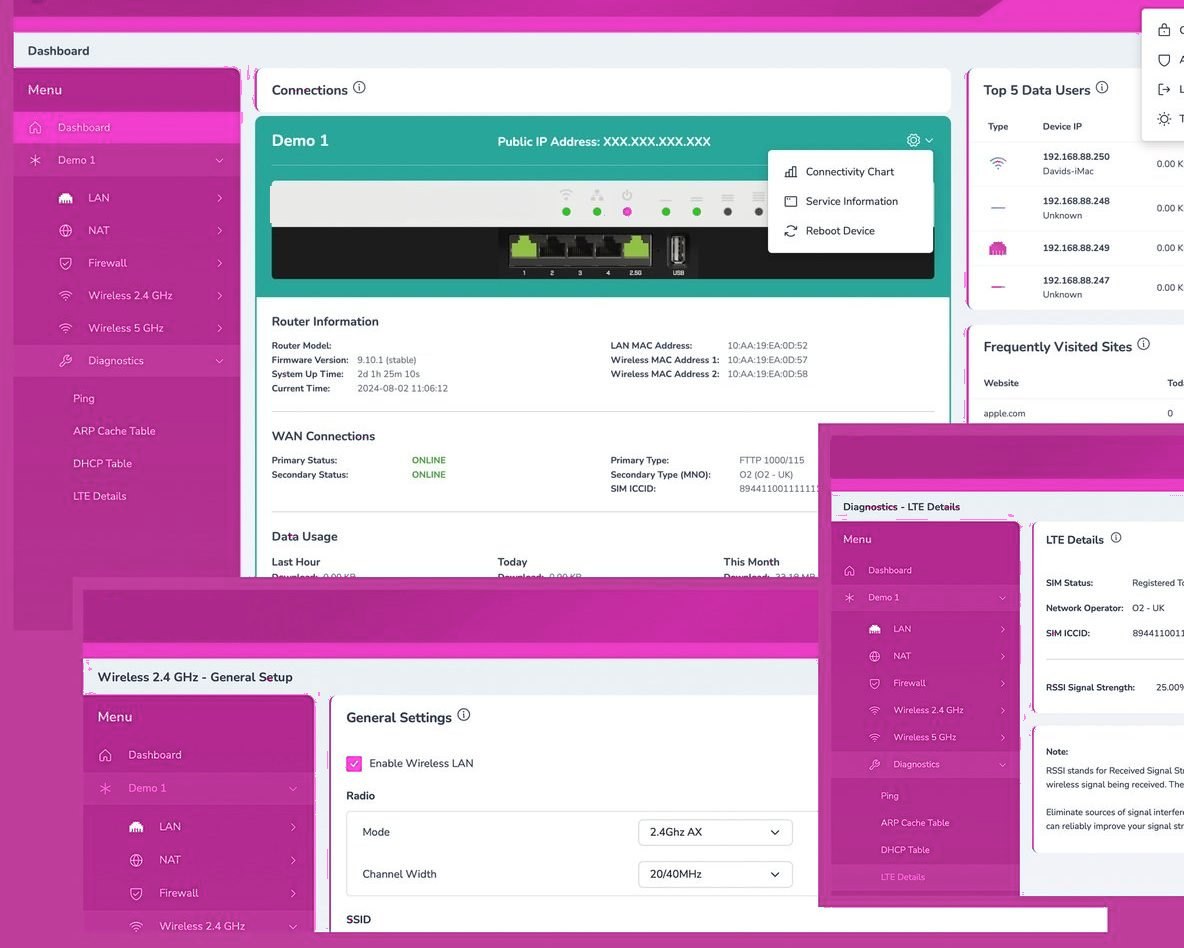
When the line fails, the SIM takes over.
The router carries two routes at once. Traffic uses the fibre; if that line drops, the 4G/5G route takes over automatically and the portal raises the alert, so phones, card machines and cloud apps carry on.
The backup SIM roams across the main UK networks, so it joins whichever signal is strongest at your address.
What we hear every week.
The frustrations behind why businesses search for business continuity solutions in the first place. If any of these feel familiar, the fix is straightforward.
Single line, single point of failure
One broadband line. When it drops, the business stops — payments, phones, cloud apps, everything. Single point of failure is the most common UK SME continuity gap.
Power failures take down phones
ISDN copper used to work through power failures via the line itself; VoIP needs power for both router and handsets. Without UPS, a brief power blip takes phones down entirely.
Carrier-level outages affect everyone
When a major carrier has a regional outage, every customer on that carrier is offline. Single-carrier dependency = single-carrier exposure.
No tested failover
Most businesses have something they describe as 'backup' that's never been tested under real outage conditions. When the real failure happens, the failover usually doesn't work as expected.
Continuity engineered for the actual failure modes
Real business continuity is designed around the failure modes you actually face — not generic 'resilience' marketing. For most UK SMEs the practical layers are: 4G/5G failover on the broadband (handles 80% of outages cheaply); UPS on critical kit (handles brief power events); automatic call routing to mobile when phones are down (preserves voice continuity even when site is offline); SD-WAN with dual circuits for genuinely mission-critical sites; tested failover procedures so when the real event happens, the failover actually works. We design and implement all of this end-to-end.
When the line drops, nothing else does.
- Multi-network SIM roams to the strongest signal
- Switch-over is automatic and monitored
- Phones, card machines and cloud apps stay live
The Telexico approach to business continuity solutions.
Six things our customers consistently tell us matter.
4G/5G failover
Auto-failover to mobile data the second the primary line drops — phones, payments, cloud apps keep working.
UPS on critical kit
Network kit, phones, key servers protected against brief power events that would otherwise take everything down.
Voice failover to mobile
When the site is offline entirely, inbound calls automatically route to mobile numbers — voice continuity preserved.
Dual-circuit / SD-WAN
For mission-critical sites, two diverse circuits from different carriers with automatic load-balancing and failover.
Tested failover procedures
We test failover regularly so it actually works when the real event happens — not theoretical 'should work' resilience.
UK 24/7 monitoring
Continuous monitoring with immediate response when failure indicators appear — often resolved before customers notice.
Built around what would actually happen if X failed
Continuity design has to start from 'what would actually happen if X failed' rather than 'what generic resilience would impress an auditor'. Different businesses have different failure-mode tolerances — restaurant losing card payments for 30 minutes is recoverable; financial services losing connectivity for 30 minutes isn't. We design around the actual cost and impact of failure for your specific business.
How it works for businesses like yours.
Three real-world setups we deliver across the UK.
Retail and hospitality with card-payment dependency
Card terminal offline = lost sales. 4G/5G failover plus dual-routed POS network handles the most common failure scenarios cheaply.
Call-dependent businesses
Customer-facing operations where phones must stay up — voice failover to mobile plus broadband failover keeps voice continuity through site outages.
Financial services and regulated firms
Mission-critical uptime requirements driven by regulation and customer SLAs — dual circuits with diverse routing, tested failover, full audit trail.
Why UK businesses pick Telexico for continuity
We design from failure modes outward rather than from features inward. We test failover regularly so the resilience is real not theoretical. We own the broadband, voice, mobile and monitoring layers so we can engineer cross-layer continuity that multi-vendor setups can't deliver. Full-stack ownership is what makes continuity actually work.
What you actually get from Telexico.
Honest about scope. No aggressive sales tactics, no surprise renewal jumps, no tier-1 call-centre triage. Real UK engineers, transparent pricing, one provider relationship across the stack.
UK-based provider
Wolverhampton-headquartered. Engineers cover the West Midlands daily; UK-wide install via our partner network. Real UK engineer support, UK data residency, UK contractual relationship — not US-routed SaaS.
Real engineer support
When you call Telexico, you reach someone who can actually fix things. Response SLA backed by real engineering capacity rather than call-centre headcount. Named account manager for ongoing customers.
Free infrastructure review
Every engagement starts with a no-obligation audit of your current setup. Honest recommendation — sometimes that's "stay with your current provider after negotiation." We'd rather be honest than oversell.
Transparent pricing
What you sign for is what you pay — including renewal. No teaser pricing that jumps 30-100% at year two. No mid-contract CPI shock. Predictable multi-year cost from day one.
One provider, one platform
Broadband, hosted VoIP, business WiFi, AI Receptionist, 4G/5G failover, CCTV consolidated onto one Telexico relationship. Single bill, single support number, single engineer when something needs attention.
Migration project-managed
Switching to Telexico isn't DIY. We handle contract audit, notice timing, ordering, parallel running, cutover, old-provider close-out. Customer-visible disruption typically measured in minutes.
Tailored around your business.
Tell us what you have now and what's frustrating you. We'll come back with a tailored review of where we can simplify, consolidate or improve it — no fixed-package pressure, no hard sell.
You may also want to read
What is Starlink for business
Starlink Business is SpaceX's commercial-grade satellite internet service for businesses. It uses a constellation of...
Leased line vs full fibre
Full fibre (FTTP) and leased lines are both fibre-optic business connectivity, but they're fundamentally different...
Openreach vs CityFibre
Most UK business broadband is delivered over one of two main fibre networks: Openreach (BT-owned, the incumbent, covers...
Business Broadband cost
Indicative UK pricing for business broadband — what affects the price, ranges, and a free tailored review.
Leased Lines cost
Indicative UK pricing for leased lines — what affects the price, ranges, and a free tailored review.
Free infrastructure review
Send us your current setup. We'll review what you have, what you pay, and where we can simplify.
Online, whatever happens.
Frequently asked questions
What's the simplest continuity improvement most UK businesses can make?
4G/5G failover. Typically £30-80/month for a 4G/5G router that auto-takes-over when primary line drops. Handles probably 80% of the practical outages most businesses face. Cheap, easy to install, immediate operational uplift.
What about power failures?
UPS on critical kit (network router, key switches, phones if desk-bound) handles brief power events. For longer power outages, mobile working becomes the answer — VoIP softphone apps and 4G/5G connectivity let staff work from anywhere with power and signal.
How does voice failover to mobile work?
Cloud VoIP platform allows inbound call routing rules — when the site phone system is unreachable, calls route to designated mobile numbers automatically. Caller experience is unchanged; staff handle calls on mobile until site is back online.
When does dual-circuit make sense?
When the cost of downtime exceeds the cost of the second circuit. For most SMEs, 4G/5G failover is sufficient. For financial services, large e-commerce platforms, mission-critical operations — dual circuits from diverse carriers with diverse physical routing become justified.
How do you test failover?
Scheduled tests that simulate primary line failure under controlled conditions. Confirms failover triggers correctly, traffic re-routes, performance is acceptable on the secondary path, and recovery to primary works cleanly. We log every test for audit purposes.
What's an SLA-backed continuity setup look like?
SLAs on primary uptime (99.95% on standard, 99.99% on enterprise leased lines), SLAs on failover trigger time (typically seconds), SLAs on response to monitoring alerts (minutes for critical), and real service credits if we miss any of them. Not best-effort.
Can you do business continuity for a customer who's not on Telexico for primary?
Yes — we can install failover and continuity solutions as overlay on whoever your primary provider is. The continuity layer is decoupled from primary connectivity. Get in touch to discuss specifics.
Apply this to your business?
Reading the guide is one thing; applying it to your specific operation is another. Send us your current setup — we'll review what you have, what fits, and where to start. No hard sell, no fixed-package pressure.