Business continuity for modern UK businesses.
What business continuity actually means in 2026 — across connectivity, communications, operations, data. Strategic guide for UK SMEs thinking about resilience, not enterprise-grade BCP frameworks.


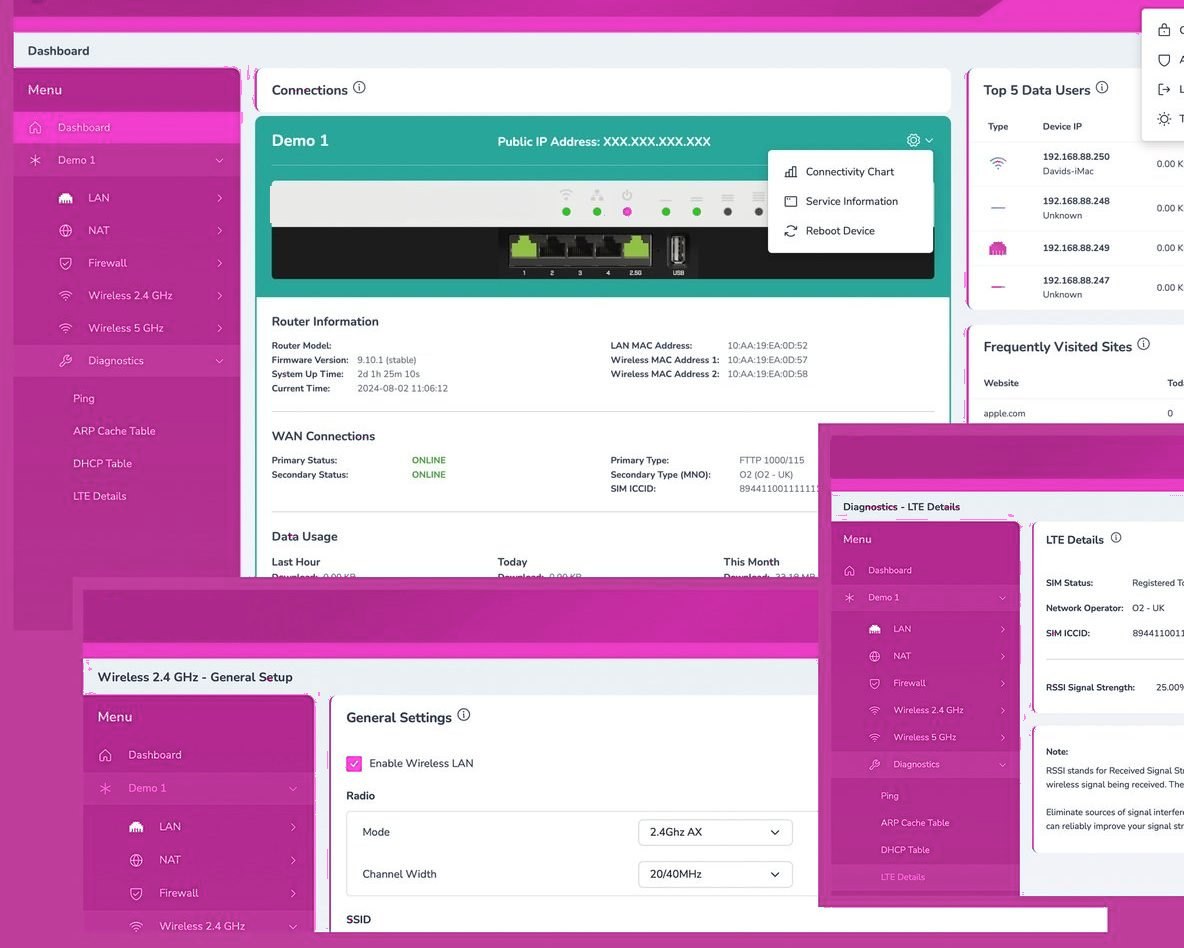
When the line fails, the SIM takes over.
The router carries two routes at once. Traffic uses the fibre; if that line drops, the 4G/5G route takes over automatically and the portal raises the alert, so phones, card machines and cloud apps carry on.
The backup SIM roams across the main UK networks, so it joins whichever signal is strongest at your address.
What we hear every week.
The frustrations behind why businesses search for business continuity for modern businesses in the first place. If any of these feel familiar, the fix is straightforward.
Enterprise BCP frameworks don't fit SMEs
ISO 22301, NIST BCP frameworks designed for large enterprises. Useful framing; impractical full implementation for typical UK SMEs.
Continuity gets ignored until something fails
Most UK SMEs don't think about continuity until they experience an outage. Then it becomes urgent — but by then the impact has already happened.
Continuity is connectivity AND more
Broadband failover is part of business continuity but not all of it. Power, data, communications, operations all need consideration.
Worry that proper continuity is expensive
Enterprise-grade BCP IS expensive. Proportionate SME continuity is genuinely affordable — and far cheaper than the events it protects against.
What business continuity actually means for UK SMEs in 2026
**Practical framework for UK SMEs.** **Connectivity continuity:** broadband failover (4G/5G or Starlink) keeps operations online during primary outages. Most impactful single intervention for most UK SMEs. **Communications continuity:** hosted VoIP plus mobile/desktop apps means phones work from anywhere — staff can work from home, mobile, alternative locations. AI receptionist provides 24/7 inbound capture even when human staff aren't available. **Data continuity:** cloud-based business systems (Microsoft 365, Google Workspace, cloud CRM) plus automated backup means data isn't tied to a single physical location. **Power continuity:** UPS for critical kit (router, switch, modem) extends uptime during short power outages; generator integration for operations where extended power loss is critical. **Premises continuity:** plan for when premises are unavailable — remote-working capability via hosted services and mobile apps. **The honest framing for UK SMEs:** start with connectivity and communications continuity (highest ROI from outage events). Add data resilience (usually already there via cloud services). Add power resilience where genuinely critical. Don't replicate enterprise BCP frameworks unprompted.
When the line drops, nothing else does.
- Multi-network SIM roams to the strongest signal
- Switch-over is automatic and monitored
- Phones, card machines and cloud apps stay live
The Telexico approach to business continuity for modern businesses.
Six things our customers consistently tell us matter.
Connectivity failover for typical outages
4G/5G or Starlink failover catches typical UK broadband outage events. Highest single ROI continuity intervention.
Communications continuity via cloud
Hosted VoIP plus mobile/desktop apps means phones work from anywhere. AI receptionist for 24/7 inbound capture.
Data continuity via cloud platforms
Microsoft 365, Google Workspace, cloud CRM — data accessible regardless of premises status. Standard for modern UK SMEs.
Power continuity where critical
UPS for critical comms kit; generator integration for extended power loss in operations that need it.
Remote-working capability
Hybrid working infrastructure (VoIP apps, cloud platforms) means staff work from anywhere — useful for both flexibility and continuity.
Sized to operational risk
Continuity tier matched to actual downtime cost — proportionate, not enterprise-grade overkill.
How to think about UK SME continuity proportionately
**Step 1 — Identify what would actually stop the business.** Primary connectivity outage? Premises unavailable? Power loss? Key system failure? Different threats need different responses. **Step 2 — Estimate impact cost per scenario.** Lost revenue, customer impact, productivity loss, regulatory consequence. **Step 3 — Match continuity tier to impact.** Light (4G failover, cloud platforms): catches most common scenarios at modest cost. Medium (Starlink + UPS + better cloud setup): higher resilience. Heavy (dual leased lines + generator + DR site): mission-critical operations. **Most UK SMEs benefit most from light tier;** few need heavy tier; don't over- or under-engineer.
How it works for businesses like yours.
Three real-world setups we deliver across the UK.
Retail — connectivity continuity primary
4G/5G failover keeps EPOS and card payments running through Openreach outages. Cloud platforms protect data. UPS for comms kit.
Healthcare — communications and data continuity
Hosted VoIP plus cloud platforms; Starlink failover for path diversity; UPS for clinical-critical equipment.
Manufacturing — comprehensive continuity
Dual leased lines plus Starlink; generator integration; remote-working capability for office staff; DR site for production-critical systems.
Why this guide reflects real UK SME continuity reality
Telexico designs business continuity for UK SMEs across hospitality, retail, healthcare, manufacturing. The practical framework reported here reflects what actually works for UK SMEs — not enterprise-grade BCP frameworks repackaged.
What you actually get from Telexico.
Honest about scope. No aggressive sales tactics, no surprise renewal jumps, no tier-1 call-centre triage. Real UK engineers, transparent pricing, one provider relationship across the stack.
UK-based provider
Wolverhampton-headquartered. Engineers cover the West Midlands daily; UK-wide install via our partner network. Real UK engineer support, UK data residency, UK contractual relationship — not US-routed SaaS.
Real engineer support
When you call Telexico, you reach someone who can actually fix things. Response SLA backed by real engineering capacity rather than call-centre headcount. Named account manager for ongoing customers.
Free infrastructure review
Every engagement starts with a no-obligation audit of your current setup. Honest recommendation — sometimes that's "stay with your current provider after negotiation." We'd rather be honest than oversell.
Transparent pricing
What you sign for is what you pay — including renewal. No teaser pricing that jumps 30-100% at year two. No mid-contract CPI shock. Predictable multi-year cost from day one.
One provider, one platform
Broadband, hosted VoIP, business WiFi, AI Receptionist, 4G/5G failover, CCTV consolidated onto one Telexico relationship. Single bill, single support number, single engineer when something needs attention.
Migration project-managed
Switching to Telexico isn't DIY. We handle contract audit, notice timing, ordering, parallel running, cutover, old-provider close-out. Customer-visible disruption typically measured in minutes.
Tailored around your business.
Tell us what you have now and what's frustrating you. We'll come back with a tailored review of where we can simplify, consolidate or improve it — no fixed-package pressure, no hard sell.
You may also want to read
What is Starlink for business
Starlink Business is SpaceX's commercial-grade satellite internet service for businesses. It uses a constellation of...
Leased line vs full fibre
Full fibre (FTTP) and leased lines are both fibre-optic business connectivity, but they're fundamentally different...
Openreach vs CityFibre
Most UK business broadband is delivered over one of two main fibre networks: Openreach (BT-owned, the incumbent, covers...
Business Broadband cost
Indicative UK pricing for business broadband — what affects the price, ranges, and a free tailored review.
Leased Lines cost
Indicative UK pricing for leased lines — what affects the price, ranges, and a free tailored review.
Free infrastructure review
Send us your current setup. We'll review what you have, what you pay, and where we can simplify.
Online, whatever happens.
Frequently asked questions
What's the difference between business continuity and disaster recovery?
Business continuity (BC) is about keeping operations running during disruption — failover, alternative working modes, communications. Disaster recovery (DR) is about restoring operations after major events — backup restoration, replacement infrastructure, data recovery. BC is preventive/concurrent; DR is reactive/restorative. Most UK SMEs need solid BC; only some justify dedicated DR investment.
Where should a UK SME start with business continuity?
Connectivity failover (4G/5G or Starlink) — highest single ROI intervention for most UK SMEs. Catches typical broadband outage events that would otherwise stop the business. Layer in communications continuity (hosted VoIP), data continuity (cloud platforms), power continuity (UPS) as operational risk justifies.
How much should a UK SME spend on business continuity?
Variable. Light tier (4G failover, basic UPS, cloud platforms): typically £50-150/month additional spend over baseline. Medium tier (Starlink failover, better UPS, premium cloud): £150-400/month. Heavy tier (dual leased lines, generator, DR site): £500-2,000+/month. Match the tier to operational risk.
What about cyber security in business continuity?
Adjacent topic. Cyber events (ransomware, breach) can stop operations and require both BC response (alternative working modes) and incident response. Standard SME cyber security (managed firewall, endpoint protection, backup with immutable retention) addresses the most common scenarios. Enterprise-grade cyber BCP is separate territory.
Do I need a written business continuity plan?
Most UK SMEs benefit from a written plan — even informal. Documents what to do when primary fails, key contacts, alternative working arrangements, customer communication plan. Doesn't need to be ISO 22301; a 2-page practical document is often more useful than a 50-page framework. Regulated operations may need more formal documentation.
How does cloud help with business continuity?
Massively. Cloud platforms (Microsoft 365, Google Workspace, cloud CRM, cloud VoIP) decouple operations from physical premises. Staff can work from anywhere with connectivity. Data isn't tied to a server that could fail. Standard modern UK SME stack inherently includes significant continuity benefit.
What about premises unavailable (flood, fire, etc.)?
Mostly handled by cloud-based operations + hosted communications + remote-working capability. Staff work from home or alternative locations; phones still work via mobile/desktop apps; data accessible via cloud platforms. Most modern UK SMEs can lose premises and continue operating within hours, not days.
Apply this to your business?
Reading the guide is one thing; applying it to your specific operation is another. Send us your current setup — we'll review what you have, what fits, and where to start. No hard sell, no fixed-package pressure.