Switching business phone systems — the process.
What switching UK business phones actually involves — number porting, hardware migration, hunt group replication, parallel running, training. A practical process guide so you know what to expect before you commit.


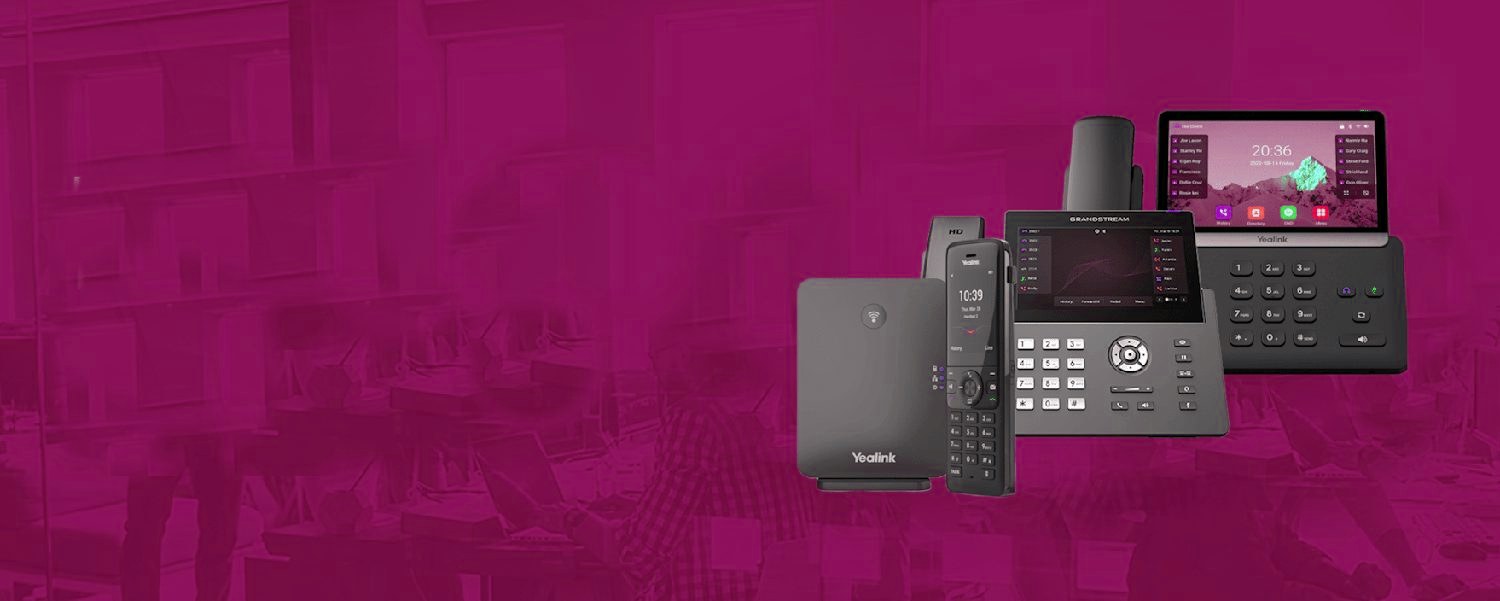
From the first ring to the recording.
The same cloud phone system routes every call the way your business works, then keeps a record of it.
What we hear every week.
The frustrations behind why businesses search for switching business phone systems in the first place. If any of these feel familiar, the fix is straightforward.
Worry about losing the business number
Existing business numbers carry years of marketing equity, stationery, Google listing, customer history. Concern about losing them stops many UK businesses from switching even when service is poor.
Complex existing setup to replicate
Hunt groups, DDIs, voicemail rules, after-hours diversions, multi-site routing — the existing routing logic needs replicating on the new platform. Done wrong, calls get lost in the migration.
Worry about staff disruption
Phone systems are daily-use tools. Switching brings new handsets, new apps, new processes — staff need training. Disruption concerns slow the switch decision.
Hardware migration questions
Existing IP handsets — do they work with the new provider? Older copper phones — what happens to them? Mobile apps — same as before or different? Practical hardware questions matter operationally.
How UK business phone switches actually run
**Stage 1 — Discovery (week 1).** Document existing setup: lines, DDIs, hunt groups, voicemail rules, mobile apps, integrations. **Stage 2 — Design and order (weeks 1-3).** New provider designs replacement platform replicating (or improving) existing routing; number porting initiated (long-lead, typically 2-4 weeks); new IP handsets ordered if needed. **Stage 3 — Build (weeks 3-5).** New hosted VoIP tenant provisioned; routing logic configured; integrations built (CRM, calendar, AI receptionist); new IP handsets shipped. **Stage 4 — Parallel running (weeks 5-7).** New phone system live on temporary numbers; staff trained on new handsets and apps; sample calls tested; routing logic verified. **Stage 5 — Cutover (week 7).** Out-of-hours number port (typically weekend); old service ceased; new service takes over. **Stage 6 — Post-cutover monitoring (weeks 8-9).** Engineer on standby; any teething issues resolved quickly; ongoing managed service relationship established.
Every seat, fully loaded.
- Call recording, the Telexico Mobile App and Telexico Web UC included
- Handsets pre-provisioned and shipped ready to plug in
- Moves, adds and changes from the portal, no engineer visit
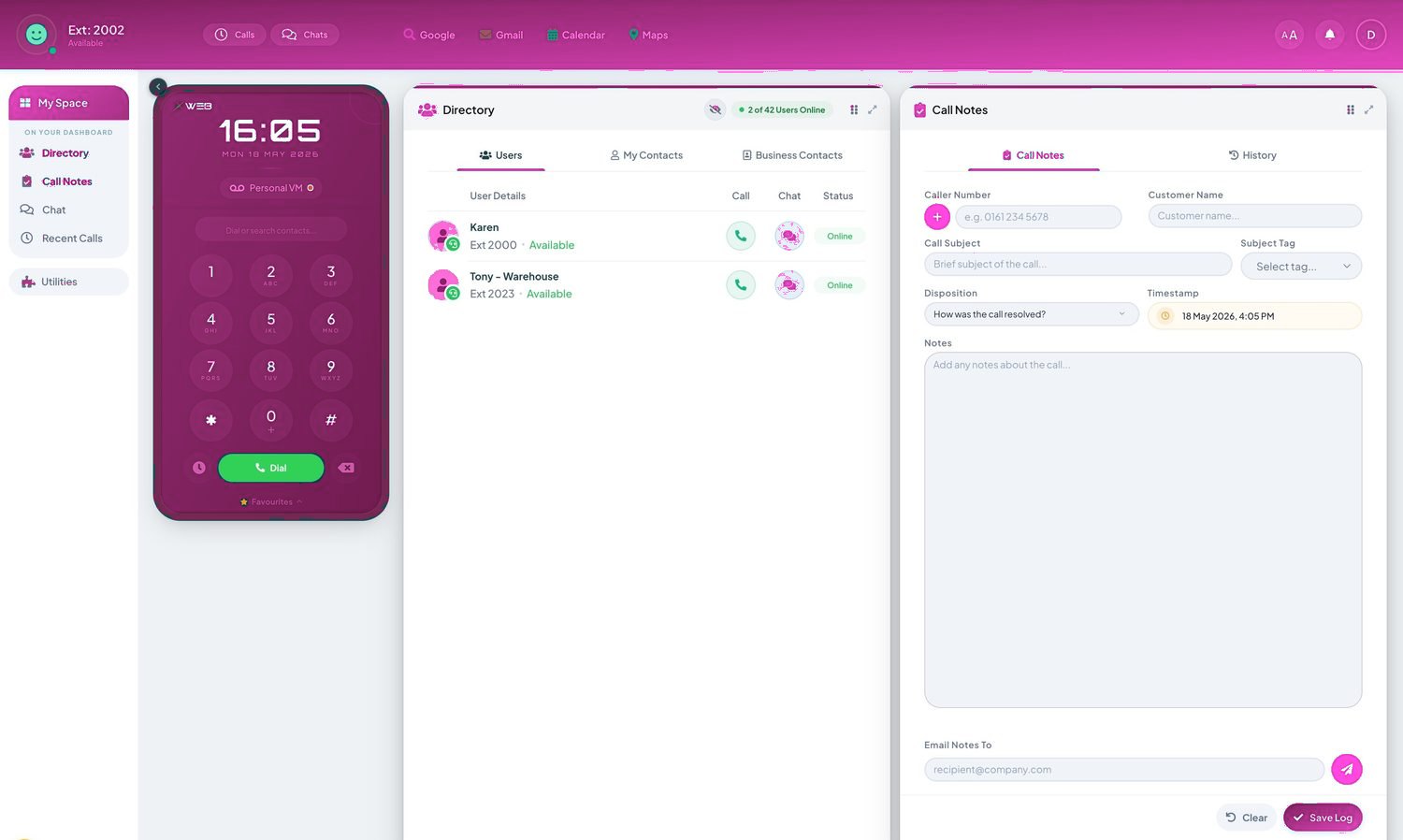
The Telexico approach to switching business phone systems.
Six things our customers consistently tell us matter.
Number porting handled cleanly
All existing UK landline numbers, DDIs and ranges transferred to new platform — no change to stationery, marketing, website or what customers dial.
Routing logic replicated faithfully
Hunt groups, DDIs, voicemail rules, after-hours diversion — all replicated on the new platform during build phase. Often improved with modern features (AI receptionist, mobile app integration).
Parallel running de-risks cutover
New phone system live for 1-2 weeks on temporary numbers before cutover. Staff trained; routing tested; integrations verified — issues caught during testing rather than after cutover.
Out-of-hours cutover
Number porting completed at a time that suits your operation — typically a weekend evening — to minimise customer-visible interruption. Most businesses experience minutes not hours of downtime.
Hardware supplied and configured
New IP handsets shipped, configured, and tested before install day. Old handsets disposed of cleanly if not compatible. Mobile and desktop apps installed before cutover.
Staff training included
Key features covered with staff before cutover — making and receiving calls, transfers, hold, voicemail, mobile app setup, hot-desking if used. Reduces day-one friction.
How UK businesses actually plan a phone switch
**Step 1 — Check old contract notice period and identify long-lead items.** Number porting (2-4 weeks lead) is usually the gating factor. **Step 2 — Document existing routing logic.** Before talking to new provider, document every hunt group, DDI, voicemail rule, after-hours diversion you currently have — this is what they'll replicate. **Step 3 — Order with realistic timeline.** Allow 6-10 weeks for a typical SME switch from order to live. **Step 4 — Communicate to team and external dependencies.** Anyone calling specific staff DDIs, anyone with the phone number in marketing collateral, any external service expecting calls from specific lines. **Step 5 — Cutover, monitoring, ongoing managed service.**
How it works for businesses like yours.
Three real-world setups we deliver across the UK.
Office on ISDN migrating to hosted VoIP
PSTN switch-off forced migration. Hosted VoIP replacing ISDN with all existing numbers and routing logic preserved.
Multi-site business consolidating phone systems
Multiple sites on different providers consolidating onto single hosted VoIP tenant. Phased site-by-site migration over 6-12 months as existing contracts end.
Microsoft 365 firm moving to Teams Phone
Existing hosted VoIP or ISDN replaced with Microsoft Teams Phone via Direct Routing. Calls inside the Teams interface staff already use; significantly cheaper than Microsoft Calling Plans.
Why UK businesses use Telexico for phone system switches
Telexico has migrated hundreds of UK businesses from ISDN, legacy hosted VoIP and on-premises PBXs to modern hosted VoIP and Microsoft Teams Phone. Project-managed delivery, on-site engineer at install, post-cutover support relationship. Wolverhampton-headquartered.
What you actually get from Telexico.
Honest about scope. No aggressive sales tactics, no surprise renewal jumps, no tier-1 call-centre triage. Real UK engineers, transparent pricing, one provider relationship across the stack.
UK-based provider
Wolverhampton-headquartered. Engineers cover the West Midlands daily; UK-wide install via our partner network. Real UK engineer support, UK data residency, UK contractual relationship — not US-routed SaaS.
Real engineer support
When you call Telexico, you reach someone who can actually fix things. Response SLA backed by real engineering capacity rather than call-centre headcount. Named account manager for ongoing customers.
Free infrastructure review
Every engagement starts with a no-obligation audit of your current setup. Honest recommendation — sometimes that's "stay with your current provider after negotiation." We'd rather be honest than oversell.
Transparent pricing
What you sign for is what you pay — including renewal. No teaser pricing that jumps 30-100% at year two. No mid-contract CPI shock. Predictable multi-year cost from day one.
One provider, one platform
Broadband, hosted VoIP, business WiFi, AI Receptionist, 4G/5G failover, CCTV consolidated onto one Telexico relationship. Single bill, single support number, single engineer when something needs attention.
Migration project-managed
Switching to Telexico isn't DIY. We handle contract audit, notice timing, ordering, parallel running, cutover, old-provider close-out. Customer-visible disruption typically measured in minutes.
Tailored around your business.
Tell us what you have now and what's frustrating you. We'll come back with a tailored review of where we can simplify, consolidate or improve it — no fixed-package pressure, no hard sell.
You may also want to read
What is Starlink for business
Starlink Business is SpaceX's commercial-grade satellite internet service for businesses. It uses a constellation of...
Leased line vs full fibre
Full fibre (FTTP) and leased lines are both fibre-optic business connectivity, but they're fundamentally different...
Openreach vs CityFibre
Most UK business broadband is delivered over one of two main fibre networks: Openreach (BT-owned, the incumbent, covers...
Business Broadband cost
Indicative UK pricing for business broadband — what affects the price, ranges, and a free tailored review.
Leased Lines cost
Indicative UK pricing for leased lines — what affects the price, ranges, and a free tailored review.
Free infrastructure review
Send us your current setup. We'll review what you have, what you pay, and where we can simplify.
Every seat, fully loaded.
Frequently asked questions
How long does switching business phones typically take?
6-10 weeks elapsed from initial discovery to cutover. Number porting (2-4 weeks) is the long-lead item. Active project work concentrated at the start (discovery and design) and the cutover window (a few hours out-of-hours). Complex multi-line or multi-site setups: 8-12 weeks.
Will I lose my business phone number?
No — number porting handles it. All existing UK landline numbers and DDI ranges transfer to the new platform without any change to stationery, marketing, website, Google listing, or what customers dial. Porting is standard and routine in 2026.
What about my existing IP handsets — can we re-use them?
Sometimes — depends on the handset model. Modern Yealink, Polycom, Cisco SPA IP phones often work with new providers via SIP. Older proprietary handsets typically don't. Switch project includes assessment of existing hardware compatibility; new handsets supplied where needed.
Will customer calls drop during cutover?
Typically a few minutes — sometimes seconds — during the actual number port. Often customer-invisible. Scheduled out-of-hours. Old service stays live until the cutover so the business runs on existing platform right up to the switch moment. Cutover-related disruption is usually trivial.
What if our hunt groups or routing logic don't transfer cleanly?
They will — replicated during build phase based on documented existing logic. Parallel running tests every hunt group and routing rule before cutover. Edge cases (unusual routing, complex DDI mappings) identified during discovery and built explicitly. Done routinely.
Should we use this moment to add AI receptionist?
Often yes — the operational uplift is significant and switch is a natural moment to add it. AI handles routine inbound during overflow and after-hours; existing reception handles complex inbound. Most UK SMEs we work with deploy AI at switch time rather than adding it later.
What about staff training and the day-one transition?
Training delivered before cutover, not after. Standard features covered with all staff (making/receiving calls, transfers, mobile apps); advanced features covered with designated admins (hunt group management, IVR admin, call recording playback). Day-one friction reduced significantly by pre-cutover training.
Apply this to your business?
Reading the guide is one thing; applying it to your specific operation is another. Send us your current setup — we'll review what you have, what fits, and where to start. No hard sell, no fixed-package pressure.