Office broadband consolidation — the typical project shape.
What a Telexico office broadband consolidation actually involves — auditing multi-provider mess, designing a single-provider stack, migrating without disruption, delivering operational simplicity. Illustrative of the kind of project we run for SME offices across the UK.
The multi-provider mess UK offices typically hit
Most UK SME offices have grown organically — broadband added from whichever provider was easiest at the time, phone system from another, WiFi installed by a third contractor, CCTV by a fourth. Five different invoices, five different support numbers, five different contract end dates. When something breaks, providers blame each other and the customer chases all of them. The total cost is usually higher than necessary; the operational cost of managing the mess adds further hidden cost. Consolidation is the proportionate response.
Five different providers across the network stack
Broadband from one company, phones from another, WiFi installed by a contractor, CCTV by a fourth, AI bolted on from a SaaS. Fragmented operations are the default if nobody designs them coherently.
Finger-pointing when things fail
Phone quality dropping. Broadband provider blames phone provider blames router supplier blames WiFi contractor. The customer chases each one separately while operations suffer.
Total cost higher than necessary
Components bought separately usually cost more than bundled. Plus operational cost of managing multiple providers — invoices, contracts, support tickets, configuration coordination. Hidden cost adds up.
No central visibility across the stack
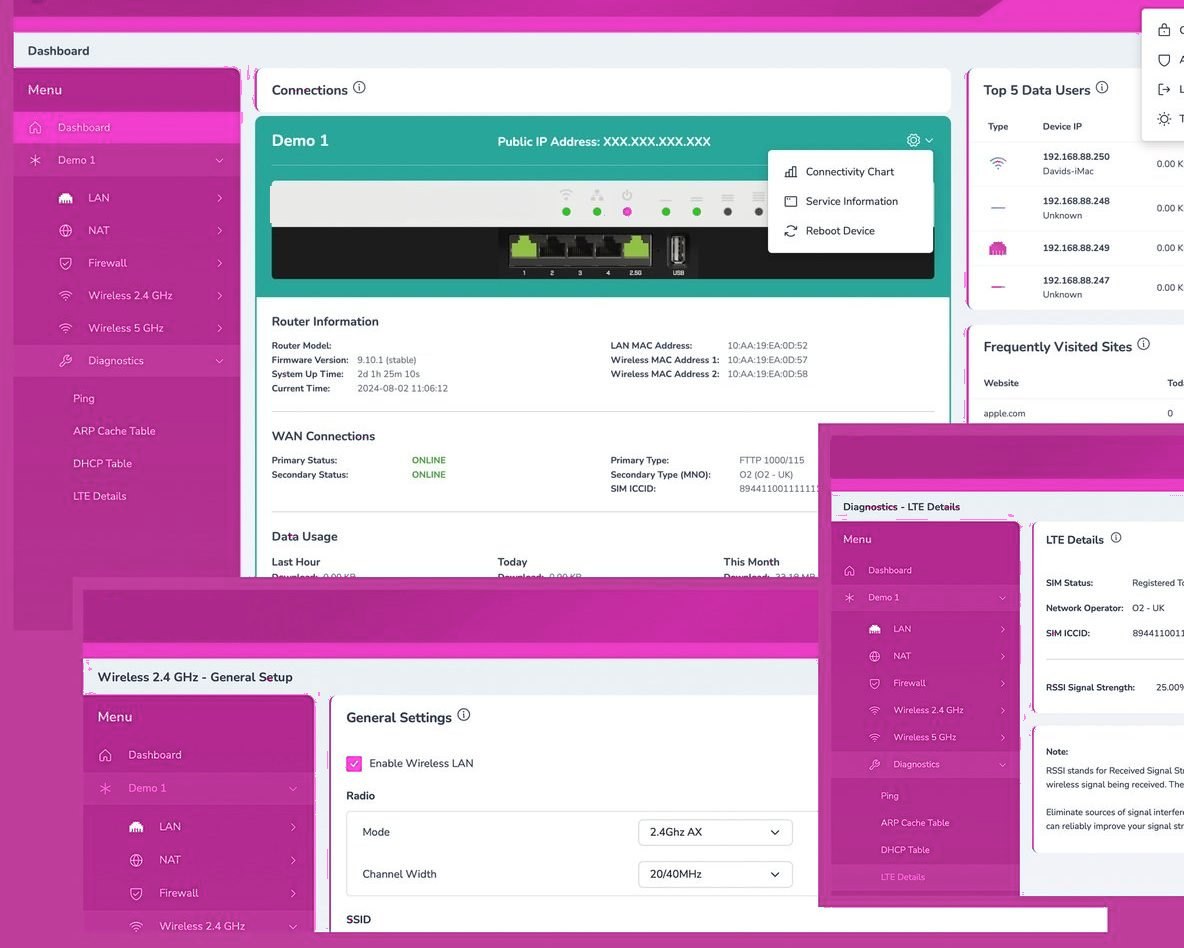
Different providers have different dashboards (or none); no integrated view of how broadband, phones and WiFi perform together. Issues fester until they become outages.
How Telexico designs the consolidation
The standard office broadband consolidation we deploy: end-to-end audit of current stack (broadband, phones, WiFi, AI, CCTV) with documented contracts, costs, support relationships, operational issues; design target state — sized to the actual operation rather than enterprise overkill, typically business FTTP plus 4G failover, hosted VoIP with mobile apps, business WiFi with VLAN segregation, AI receptionist bundled, optional CCTV via Telexico Security; phased migration plan timed around existing contract end dates so nothing breaks commercially; single account manager owning the portfolio post-migration.
How the deployment ran.
Typical project shape: 12-24 months elapsed to full consolidation, with phased migrations as existing contracts end. Operational uplift starts from the first component migrated; total simplification builds gradually.
Month 1 — Audit and design
Comprehensive audit of current stack: broadband, phones, WiFi, AI, CCTV. Documented contracts, costs, contract end dates, operational issues. Target state designed; phased migration plan timed around existing commercials.
Months 2-12 — Phased component migration
Components migrated as existing contracts end. Typical order: phones first (PSTN switch-off deadline forces it anyway), broadband second (largest cost saving), WiFi third (often runs longer on existing contract), AI added or bundled at appropriate point.
Months 12-24 — Optimisation and single relationship
Once all components on Telexico: ongoing optimisation, capacity tuning, integration deepening. Single Telexico account manager owns the relationship; single bill consolidates costs; single support number handles all incidents.
What changes operationally
The observable shifts across office consolidations follow a consistent pattern — though specific numbers vary by starting state and office size.
Single provider relationship
One Telexico account manager, one bill, one support number across the whole network stack. No finger-pointing when something fails — Telexico owns the resolution end-to-end.
Total cost typically reduces 15-30%
Bundle pricing meaningfully cheaper than equivalent multi-provider stack. Plus operational cost savings on managing fewer providers — staff time reclaimed, fewer surprise invoices, predictable monthly cost.
Central visibility across the stack
Telexico monitors broadband, router, switches, APs, phones, AI, CCTV from one place. Issues detected before users notice. Capacity and performance visible across components.
The technical configuration
Standard office consolidation stack: Openreach FTTP or CityFibre (typically 300-1Gbps) as primary connection; 4G/5G failover via managed dual-WAN router; managed firewall with QoS for voice traffic; switches with PoE for APs and IP phones; structured CAT6 cabling to workstations and AP locations; business WiFi (typically Ubiquiti UniFi APs) with corporate, guest, and IoT/CCTV VLAN segregation; hosted VoIP with IP handsets and mobile/desktop apps; AI receptionist integrated natively with hosted VoIP; optional CCTV via Telexico Security; 24/7 monitoring and central management. Single Telexico bill, single support relationship, SLA-backed UK engineer response.
What you actually get from Telexico.
Honest about scope. No aggressive sales tactics, no surprise renewal jumps, no tier-1 call-centre triage. Real UK engineers, transparent pricing, one provider relationship across the stack.
UK-based provider
Wolverhampton-headquartered. Engineers cover the West Midlands daily; UK-wide install via our partner network. Real UK engineer support, UK data residency, UK contractual relationship — not US-routed SaaS.
Real engineer support
When you call Telexico, you reach someone who can actually fix things. Response SLA backed by real engineering capacity rather than call-centre headcount. Named account manager for ongoing customers.
Free infrastructure review
Every engagement starts with a no-obligation audit of your current setup. Honest recommendation — sometimes that's "stay with your current provider after negotiation." We'd rather be honest than oversell.
Transparent pricing
What you sign for is what you pay — including renewal. No teaser pricing that jumps 30-100% at year two. No mid-contract CPI shock. Predictable multi-year cost from day one.
One provider, one platform
Broadband, hosted VoIP, business WiFi, AI Receptionist, 4G/5G failover, CCTV consolidated onto one Telexico relationship. Single bill, single support number, single engineer when something needs attention.
Migration project-managed
Switching to Telexico isn't DIY. We handle contract audit, notice timing, ordering, parallel running, cutover, old-provider close-out. Customer-visible disruption typically measured in minutes.
Want a similar review for your business?
Tell us what you have now and what's frustrating you. We'll come back with a tailored review of where we can simplify, consolidate or improve it — no fixed-package pressure, no hard sell.
You may also want to read
Restaurant connectivity upgrade
What a Telexico restaurant connectivity upgrade actually involves — from initial site survey through cutover to ongoing...
Hotel guest wifi installation
What a Telexico hotel guest wifi project actually involves. Illustrative of independent hotel deployments across the UK...
Warehouse network upgrade
What a Telexico warehouse network project actually involves. Illustrative of UK light-industrial deployments —...
What is Starlink for business
Starlink Business is SpaceX's commercial-grade satellite internet service for businesses. It uses a constellation of...
Leased line vs full fibre
Full fibre (FTTP) and leased lines are both fibre-optic business connectivity, but they're fundamentally different...
Free infrastructure review
Send us your current setup. We'll review what you have, what you pay, and where we can simplify.
Fibre that stays up.
Frequently asked questions
Do I have to migrate everything at once?
No — phased migration is the standard approach. Components migrate as existing contracts end so commercial commitments aren't broken. Typical 12-24 months elapsed to full consolidation. New requirements go straight to Telexico; legacy components migrate gradually.
Will operations be disrupted during consolidation?
No — each component migration is project-managed with parallel running. Old and new run simultaneously during cutover; switchover scheduled out-of-hours where possible. Most office staff don't notice migrations happening.
How much does office consolidation typically save?
Variable — depends on current multi-provider stack and contract terms. Indicative: 15-30% reduction in direct monthly cost is common, plus operational cost savings (fewer invoices to manage, fewer support relationships, fewer surprise issues). Real savings calculated during audit.
What if some of our existing providers are actually pretty good?
Honest answer: not everything has to migrate. If a specific provider delivers genuinely good service in a niche domain (e.g. specialised CRM with deep integration), consolidating that one for the sake of it may not be worth it. We're honest about scope during audit; consolidation is the recommendation when it actually improves outcomes.
Can you do consolidation across multiple offices?
Yes — standard approach for multi-site consolidations. Per-site infrastructure sized to that site's operation; central monitoring and management across the portfolio; consolidated billing; one account manager. Phased site-by-site migration as existing contracts end.
What does the audit phase cost?
Typically free for prospective Telexico customers. We document your current stack, identify consolidation opportunities, and present commercial options. No-obligation — you decide whether to proceed. The consolidation itself has project fees scaled to scope.
Is there a risk in vendor concentration?
Some. If Telexico has a major incident, multiple components could be affected simultaneously. Mitigated by Telexico's own infrastructure resilience and the fact that critical components have their own failover (4G/5G or Starlink for broadband). For most UK SMEs the operational benefits of consolidation outweigh the concentration risk; some larger operations choose deliberate multi-provider strategy for resilience reasons.
Want a similar review for your business?
This is the typical project shape Telexico runs. Send us your current setup and what's frustrating you — we'll review what you have today and tailor a project that fits. No hard sell, no fixed-package pressure.