Switching business broadband provider — the process.
What switching UK business broadband actually involves — lead times, parallel running, cutover, static IPs, contract overlap. A practical process guide so you know what to expect before you commit.


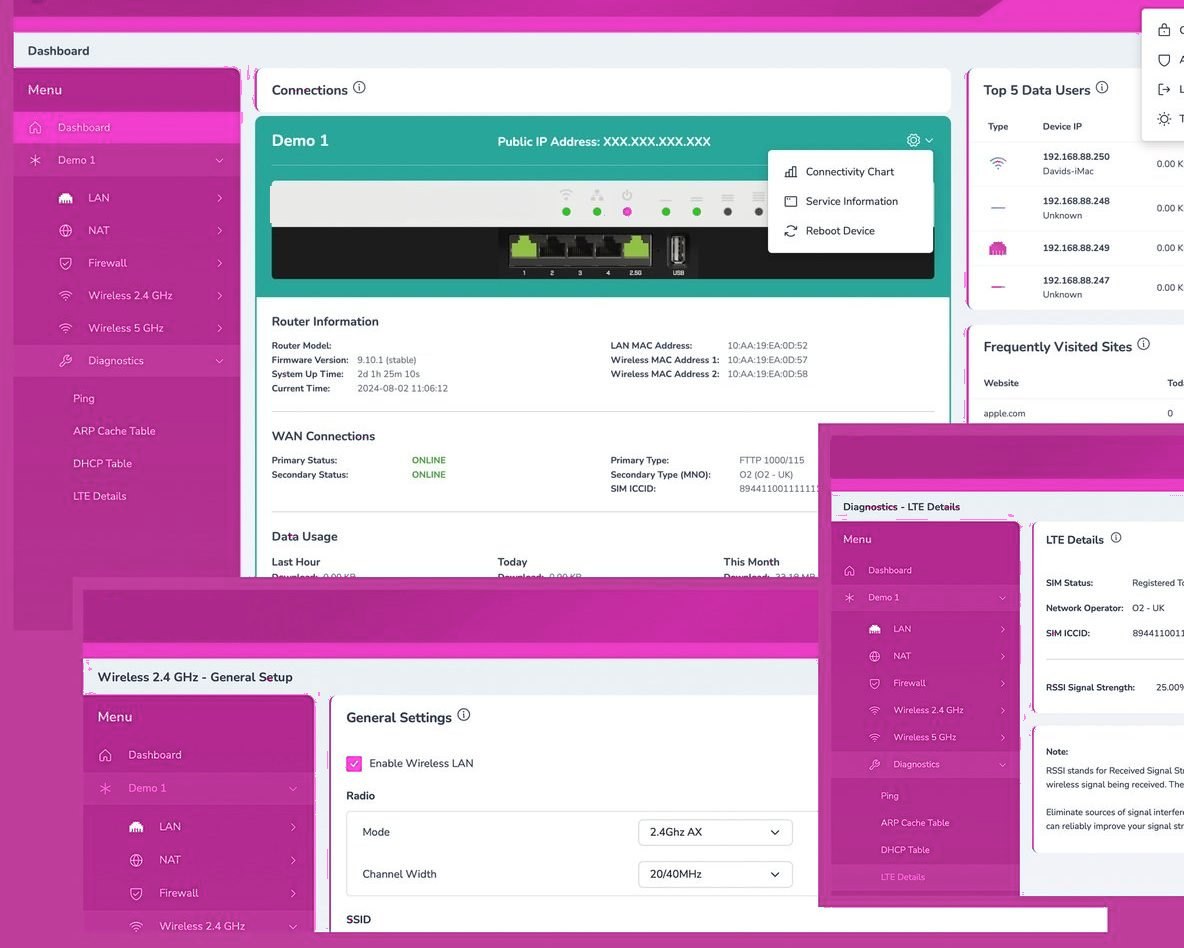
Fibre to the building, managed to the desk.
Full fibre (FTTP) runs fibre all the way into your premises over the Openreach or CityFibre network. Telexico supplies the managed router, checks what each carrier can deliver at your postcode and keeps it monitored.
Need the same speed up as down, guaranteed? That is a dedicated leased line, on the next page of the range.
What we hear every week.
The frustrations behind why businesses search for switching business broadband provider in the first place. If any of these feel familiar, the fix is straightforward.
Unclear what switching actually involves
Most UK SMEs haven't switched broadband in years — or ever. The process feels opaque. Providers don't explain it well because they want you focused on signing, not on what happens next.
Worry about downtime during switch
Mid-day broadband outages aren't acceptable for most UK businesses. The cutover concern is the most common reason businesses hesitate to switch — even when their current service is poor.
Static IP and configuration complications
Existing static IPs (for VPNs, firewalls, hosted services) don't transfer between providers. Switching means new IPs and reconfiguration. Manageable but needs planning.
Contract overlap commercial concerns
What happens if the new provider installs before the old contract ends? Do you pay both? UK switching nearly always involves brief overlap — needs commercial handling.
How UK business broadband switches actually run
**Stage 1 — Discovery and order (week 1).** New provider audits the address (Openreach/CityFibre coverage, current cabling, install requirements); commercial agreed; install order placed. **Stage 2 — Install (weeks 2-6 typically).** New provider's install proceeds: physical line install if needed (Openreach FTTP typically 2-6 weeks; leased line 6-12 weeks), router and any in-building equipment delivered, line tested and provisioned. **Stage 3 — Parallel running (weeks 6-8).** Both old and new services live simultaneously for typically 1-2 weeks. Staff test new service; any configurations migrated; firewalls and VPNs pointed at new IPs; static-IP-dependent services reconfigured. **Stage 4 — Cutover (week 8).** New service becomes primary; staff use new service for daily operation; old service kept as standby for a few more days. **Stage 5 — Old service cessation (week 9).** Once new service has run cleanly for 1-2 weeks, old contract terminated (notice period required). Commercial overlap (typically 2-4 weeks of dual billing) is the trade-off for zero operational disruption.
Built to stay up.
- Full fibre, SoGEA or a leased line, chosen from the survey
- Automatic 4G/5G failover available on every business set-up
- Monitored from the Telexico portal, supported by a named UK engineer
The Telexico approach to switching business broadband provider.
Six things our customers consistently tell us matter.
Project-managed throughout
Modern UK business broadband providers project-manage switches end-to-end — discovery, install, parallel running, cutover, old-service cessation. No DIY required from your team.
Parallel running prevents downtime
Old and new services overlap for 1-2 weeks during cutover. Staff test the new service while old is still live; switchover happens when ready, not under pressure.
Static IP migration handled
New IPs delivered with the new service; reconfiguration of firewalls, VPNs and hosted services planned and executed during parallel running. Anything pointing at your old static IP gets updated.
Existing phone numbers transferred cleanly
If phones are bundled with broadband at the old provider, number porting moves them to the new platform. Stationery, marketing and Google listing unaffected.
Failover testing during overlap
If new service includes failover (4G/5G/Starlink), it's tested and tuned during parallel running rather than discovered in production.
UK provider support throughout
Single project manager and named account manager at new provider handles questions, schedules cutover, coordinates with old provider where required.
How UK businesses actually plan the switch
**Step 1 — Check old contract notice period.** Most UK business broadband requires 30-90 days written notice. Diary the deadline. **Step 2 — Get new quote and confirm address coverage.** New provider should confirm FTTP/CityFibre/leased line availability before commercial commitment. **Step 3 — Place new order timed around old contract end.** Allow 4-8 weeks lead time for new install; aim for new service live before old service ceases so parallel running works. **Step 4 — Communicate to team and any external dependencies.** Anyone with VPN access, firewall rules, hosted services pointing at old IPs needs notice. **Step 5 — Cutover and old-service cessation.** Scheduled smoothly; old service ceased after 1-2 weeks of clean new-service operation.
How it works for businesses like yours.
Three real-world setups we deliver across the UK.
Office on FTTC switching to FTTP
Existing FTTC contract ending; FTTP now available at the address; switch to faster more reliable service with proper parallel running and cutover.
Restaurant switching after card-terminal failures
Existing service causing payment outages during service; switch to FTTP plus 4G failover with parallel running to avoid further outages during transition.
Manufacturer adding leased line resilience
Existing business FTTP being supplemented or replaced with SLA-backed leased line plus genuine failover; phased migration rather than hard cutover.
Why UK businesses use Telexico for broadband switches
Telexico project-manages broadband switches end-to-end for UK SMEs. Free pre-switch review of your current setup and what you'd be switching to. Honest about timing, what to expect, what could go wrong — not transactional sales-and-disappear.
What you actually get from Telexico.
Honest about scope. No aggressive sales tactics, no surprise renewal jumps, no tier-1 call-centre triage. Real UK engineers, transparent pricing, one provider relationship across the stack.
UK-based provider
Wolverhampton-headquartered. Engineers cover the West Midlands daily; UK-wide install via our partner network. Real UK engineer support, UK data residency, UK contractual relationship — not US-routed SaaS.
Real engineer support
When you call Telexico, you reach someone who can actually fix things. Response SLA backed by real engineering capacity rather than call-centre headcount. Named account manager for ongoing customers.
Free infrastructure review
Every engagement starts with a no-obligation audit of your current setup. Honest recommendation — sometimes that's "stay with your current provider after negotiation." We'd rather be honest than oversell.
Transparent pricing
What you sign for is what you pay — including renewal. No teaser pricing that jumps 30-100% at year two. No mid-contract CPI shock. Predictable multi-year cost from day one.
One provider, one platform
Broadband, hosted VoIP, business WiFi, AI Receptionist, 4G/5G failover, CCTV consolidated onto one Telexico relationship. Single bill, single support number, single engineer when something needs attention.
Migration project-managed
Switching to Telexico isn't DIY. We handle contract audit, notice timing, ordering, parallel running, cutover, old-provider close-out. Customer-visible disruption typically measured in minutes.
Tailored around your business.
Tell us what you have now and what's frustrating you. We'll come back with a tailored review of where we can simplify, consolidate or improve it — no fixed-package pressure, no hard sell.
You may also want to read
What is Starlink for business
Starlink Business is SpaceX's commercial-grade satellite internet service for businesses. It uses a constellation of...
Leased line vs full fibre
Full fibre (FTTP) and leased lines are both fibre-optic business connectivity, but they're fundamentally different...
Openreach vs CityFibre
Most UK business broadband is delivered over one of two main fibre networks: Openreach (BT-owned, the incumbent, covers...
Business Broadband cost
Indicative UK pricing for business broadband — what affects the price, ranges, and a free tailored review.
Leased Lines cost
Indicative UK pricing for leased lines — what affects the price, ranges, and a free tailored review.
Free infrastructure review
Send us your current setup. We'll review what you have, what you pay, and where we can simplify.
Fibre that stays up.
Frequently asked questions
How long does switching business broadband typically take?
4-8 weeks elapsed from order to live new service, then 1-2 weeks parallel running, then cutover, then 1-2 more weeks before old service cessation. So 6-12 weeks total from order placed to old contract terminated. Faster for simple FTTP-to-FTTP switches at the same address; longer for new leased lines or complex multi-site.
Will I have any broadband downtime during the switch?
Properly project-managed switches have effectively zero broadband downtime. Parallel running means old service is live throughout the new service install. Cutover is a controlled out-of-hours event with both services running. Most UK businesses experience minutes (not hours) of brief interruption during the actual switch moment, often customer-invisible.
Do I pay both providers during parallel running?
Briefly yes — typically 2-4 weeks of dual billing during parallel running and old-service notice period. This is the commercial trade-off for zero operational disruption. Some providers offer transition credits; some don't. We're honest about the overlap cost during initial scoping.
What happens to my static IPs and firewall rules?
Old static IPs cease with the old contract; new provider issues new static IPs (typically /29 or /30 block) with the new service. Firewalls, VPNs, port forwarding rules, and any hosted services pointing at your old IPs need updating. Planned during the parallel running period; rolled out gradually rather than all at once at cutover.
Can I keep my existing business phone numbers?
Yes — number porting handles UK landline number transfer. If phones come with the broadband (bundled hosted VoIP), porting happens as part of the switch; if phones are separate, porting can be coordinated separately. Existing stationery, marketing, Google listing all continue working unchanged.
What if the new install hits problems?
Project manager handles. Common issues: Openreach install delays, in-building cabling complications, premises access issues. These delay the timeline rather than affecting current service (which keeps running). Build a buffer into the contract-end timing where possible.
Should I switch broadband and phones at the same time?
Usually yes if both contracts are due — operational simplicity of single provider often outweighs the slightly larger coordinated migration. If contracts end at different times, phase the switches rather than break the operational commercial. We scope the right approach during free infrastructure review.
Apply this to your business?
Reading the guide is one thing; applying it to your specific operation is another. Send us your current setup — we'll review what you have, what fits, and where to start. No hard sell, no fixed-package pressure.