Contract end business broadband — your options.
Your business broadband contract is ending. Here are the practical options — auto-renew, renegotiate, switch, or upgrade to better service — with honest framing on when each fits.


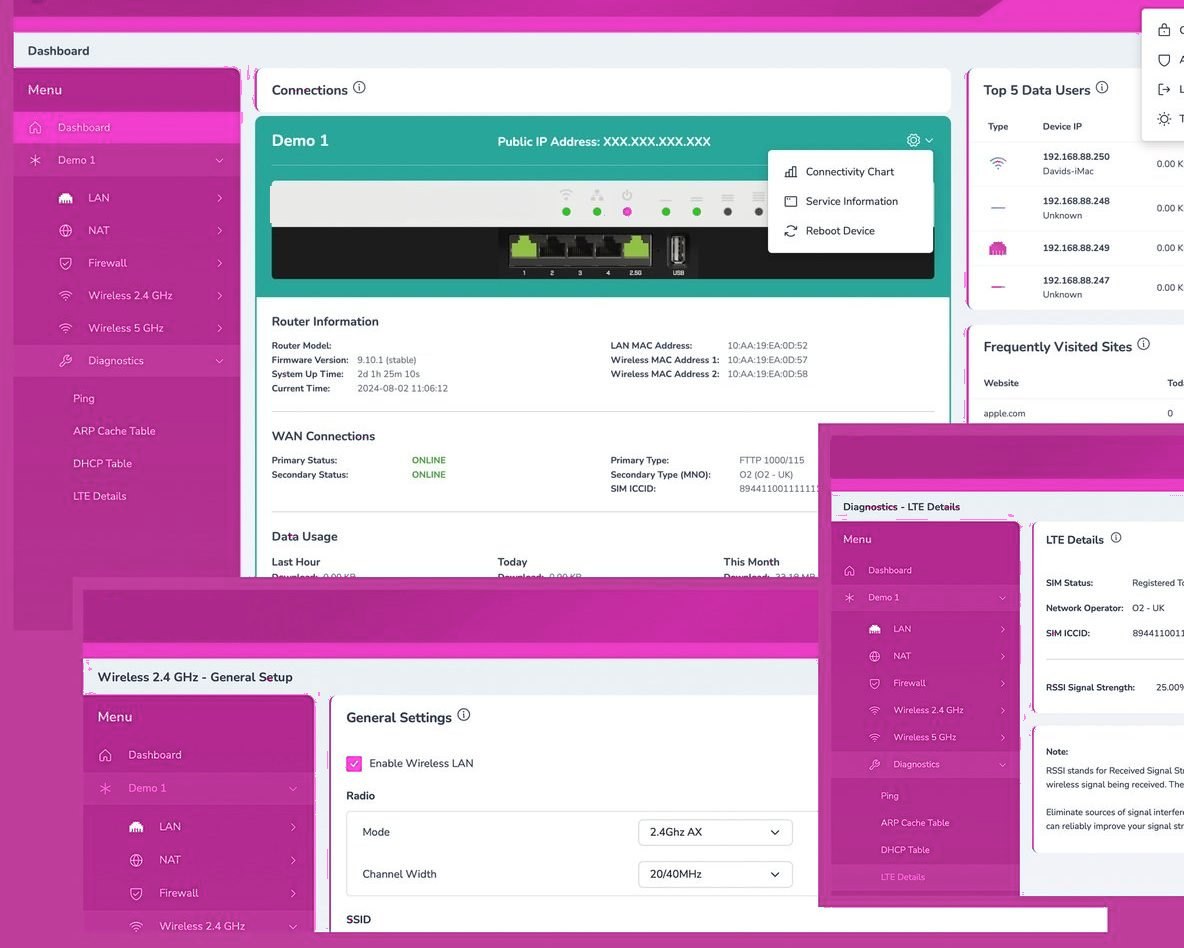
Fibre to the building, managed to the desk.
Full fibre (FTTP) runs fibre all the way into your premises over the Openreach or CityFibre network. Telexico supplies the managed router, checks what each carrier can deliver at your postcode and keeps it monitored.
Need the same speed up as down, guaranteed? That is a dedicated leased line, on the next page of the range.
What we hear every week.
The frustrations behind why businesses search for contract end business broadband options in the first place. If any of these feel familiar, the fix is straightforward.
Time pressure as contract end approaches
Most UK business broadband contracts auto-renew unless you give 30-90 days' written notice. Miss the window and you're locked in for another 12-36 months on whatever pricing the provider chose.
Pricing changes since original contract
Original contract pricing usually reflects new-customer acquisition rates. Renewal pricing usually reflects retention rates — typically higher. Most UK businesses pay more for the same service at renewal than at acquisition.
Service has aged but business has grown
What suited your business 2-3 years ago when you signed may not fit today. Growth, hybrid working, cloud adoption, more devices — operational reality changes faster than legacy contracts.
Market has moved since you last looked
FTTP coverage has expanded; CityFibre has built in new areas; altnet pricing has shifted; PSTN switch-off has accelerated. Whatever the market looked like 2-3 years ago is not what it looks like now.
Four honest options at contract end
**Option 1 — Auto-renew as offered.** Default if you do nothing. Usually the worst commercial outcome — renewal pricing rarely reflects current market. Suits operations where avoiding any change strongly outweighs cost considerations. **Option 2 — Renegotiate with incumbent.** Call retention armed with a competitive quote; most UK providers reduce price meaningfully when challenged. Works often, especially with the major providers; requires effort and a real alternative quote to be credible. **Option 3 — Switch to better-fit provider.** If incumbent commercials aren't competitive or service has been frustrating, switching is the right answer. Modern switches handle parallel running so disruption is minimal. **Option 4 — Upgrade to better service at switch.** Many UK businesses contract end is the natural moment to also upgrade — FTTC to FTTP, residential-grade to business-grade, single line to line plus failover. Switching is happening anyway; might as well land on the right service rather than just the same service at a different provider.
Built to stay up.
- Full fibre, SoGEA or a leased line, chosen from the survey
- Automatic 4G/5G failover available on every business set-up
- Monitored from the Telexico portal, supported by a named UK engineer
The Telexico approach to contract end business broadband options.
Six things our customers consistently tell us matter.
Know the renewal date and notice window
Diary the contract end date and the notice-period deadline — typically 30-90 days before. Acting before notice deadline preserves all options.
Audit what's actually available now
FTTP coverage, CityFibre availability, altnet expansion, leased line pricing — UK broadband market has moved. Address audit confirms what's deployable at your specific premises.
Competitive quote arms the negotiation
Even if staying with incumbent is the eventual answer, a competitive quote gives the retention team a specific number to match. Without it, retention has no incentive to flex.
Total-cost view including failover and bundles
Compare like-for-like total cost, not just monthly broadband cost. Bundle pricing (broadband + phones + WiFi + AI) often beats separate purchases meaningfully.
Phased upgrade where appropriate
If service is mostly fine but specific gaps need filling (failover, AI receptionist, multi-site consistency), phased changes during renewal often better than full switch.
Honest infrastructure review from Telexico
Free no-obligation review of current setup, address coverage, commercial options. Recommendation honest — sometimes 'stay where you are on renegotiated terms' is the answer.
Decision framework for UK businesses at contract end
**If your current service has been frustrating** (outages, support issues, billing surprises): switching is usually the right answer; contract end is the operational moment to do it. **If service has been broadly fine but pricing is creeping up**: renegotiate first; if incumbent matches, stay; if not, switch. **If service has been fine and pricing is reasonable**: auto-renew might be the right call — operational simplicity has value. **If your business has materially grown or changed**: review fit, not just price — what worked 3 years ago may not fit now. **If contract end coincides with PSTN switch-off**: the migration is forced anyway; might as well upgrade the rest of the stack at the same time.
How it works for businesses like yours.
Three real-world setups we deliver across the UK.
Stable SME with fine service and creeping price
Service has been broadly fine for 2-3 years; renewal pricing notably higher than original. Renegotiate first; switch only if incumbent won't match competitive quote.
Hospitality with EPOS-critical broadband
Restaurant or retail where broadband downtime stops card payments. Contract end is the moment to add proper failover and reconsider whether incumbent has been delivering reliability.
Growing manufacturer with multi-site complexity
Original single-site contract no longer fits multi-site operation. Contract end is the moment to consolidate onto a portfolio-wide solution rather than renew site-by-site.
Why UK businesses use Telexico at contract end
Telexico provides free no-obligation infrastructure reviews including honest commercial assessment at contract end. Wolverhampton-headquartered UK provider with real engineers, named account managers, transparent UK billing. Sometimes the recommendation is 'stay where you are on renegotiated terms' — we say that if it's accurate.
What you actually get from Telexico.
Honest about scope. No aggressive sales tactics, no surprise renewal jumps, no tier-1 call-centre triage. Real UK engineers, transparent pricing, one provider relationship across the stack.
UK-based provider
Wolverhampton-headquartered. Engineers cover the West Midlands daily; UK-wide install via our partner network. Real UK engineer support, UK data residency, UK contractual relationship — not US-routed SaaS.
Real engineer support
When you call Telexico, you reach someone who can actually fix things. Response SLA backed by real engineering capacity rather than call-centre headcount. Named account manager for ongoing customers.
Free infrastructure review
Every engagement starts with a no-obligation audit of your current setup. Honest recommendation — sometimes that's "stay with your current provider after negotiation." We'd rather be honest than oversell.
Transparent pricing
What you sign for is what you pay — including renewal. No teaser pricing that jumps 30-100% at year two. No mid-contract CPI shock. Predictable multi-year cost from day one.
One provider, one platform
Broadband, hosted VoIP, business WiFi, AI Receptionist, 4G/5G failover, CCTV consolidated onto one Telexico relationship. Single bill, single support number, single engineer when something needs attention.
Migration project-managed
Switching to Telexico isn't DIY. We handle contract audit, notice timing, ordering, parallel running, cutover, old-provider close-out. Customer-visible disruption typically measured in minutes.
Tailored around your business.
Tell us what you have now and what's frustrating you. We'll come back with a tailored review of where we can simplify, consolidate or improve it — no fixed-package pressure, no hard sell.
You may also want to read
What is Starlink for business
Starlink Business is SpaceX's commercial-grade satellite internet service for businesses. It uses a constellation of...
Leased line vs full fibre
Full fibre (FTTP) and leased lines are both fibre-optic business connectivity, but they're fundamentally different...
Openreach vs CityFibre
Most UK business broadband is delivered over one of two main fibre networks: Openreach (BT-owned, the incumbent, covers...
Business Broadband cost
Indicative UK pricing for business broadband — what affects the price, ranges, and a free tailored review.
Leased Lines cost
Indicative UK pricing for leased lines — what affects the price, ranges, and a free tailored review.
Free infrastructure review
Send us your current setup. We'll review what you have, what you pay, and where we can simplify.
Fibre that stays up.
Frequently asked questions
When should I start reviewing options before contract end?
60-90 days before contract end. This gives enough time to: confirm exact notice period requirements, get competitive quotes, negotiate with incumbent, and either renew on better terms or organise a clean switch with proper parallel running. Starting earlier is fine; starting later limits options and risks auto-renewal.
How much can I typically negotiate off renewal pricing?
Variable by provider and contract value. Indicative ranges: 10-30% off initial renewal offer is common when armed with specific competitive quotes; sometimes more for high-value or long-standing contracts. Some providers are more flexible than others (BT and Vodafone tend to flex; some altnets less so). Worth the conversation regardless.
What if I want to stay with my current provider but get better terms?
Standard approach: get a competitive quote from another provider; call current provider's retention team; mention the specific quote and ask for matching terms. Most UK retention teams respond positively to credible competitive quotes. Even if you ultimately stay, you've established a fair commercial baseline.
What if my provider auto-renewed me without my noticing?
Check your contract for an auto-renewal cooling-off provision (some UK providers have one, especially after CMA pressure on small-business auto-renewals). If not, you may be locked in — but renegotiation is still often possible. Lessons learned for next renewal: diary the notice deadline as soon as a contract starts, not as it ends.
Should we consolidate with phones and other services at contract end?
Often yes — bundle pricing typically meaningfully cheaper than separate services, and the operational simplicity has real value. Many UK SMEs use broadband contract end as the moment to also review phones, WiFi and AI. Coordinated approach often works better than phased; we scope during free infrastructure review.
What does Telexico's contract-end review involve?
Send us your current contract details, what you pay, what's been working, what's been frustrating. We audit address coverage (Openreach, CityFibre, altnet availability); benchmark your pricing against current market; identify whether switching would deliver meaningful uplift or whether renegotiation with incumbent is the better play. Free, no obligation, no high-pressure follow-up.
Is there a downside to switching providers at contract end?
Disruption risk is the main one — even well-managed switches have a small possibility of teething issues. Static IPs change; integrations need updating; staff adapt to new provider relationship. For most UK SMEs the disruption is minimal (parallel running, scheduled cutover, etc); for some operations where any risk is unacceptable, renegotiating with incumbent is the safer play.
Apply this to your business?
Reading the guide is one thing; applying it to your specific operation is another. Send us your current setup — we'll review what you have, what fits, and where to start. No hard sell, no fixed-package pressure.