Business broadband contract renewal — your options.
Your contract is ending. Auto-renew at the same provider, negotiate, or switch — each has trade-offs. An honest guide to UK business broadband contract renewal, what your incumbent is hoping you'll do, and how to make an informed decision.


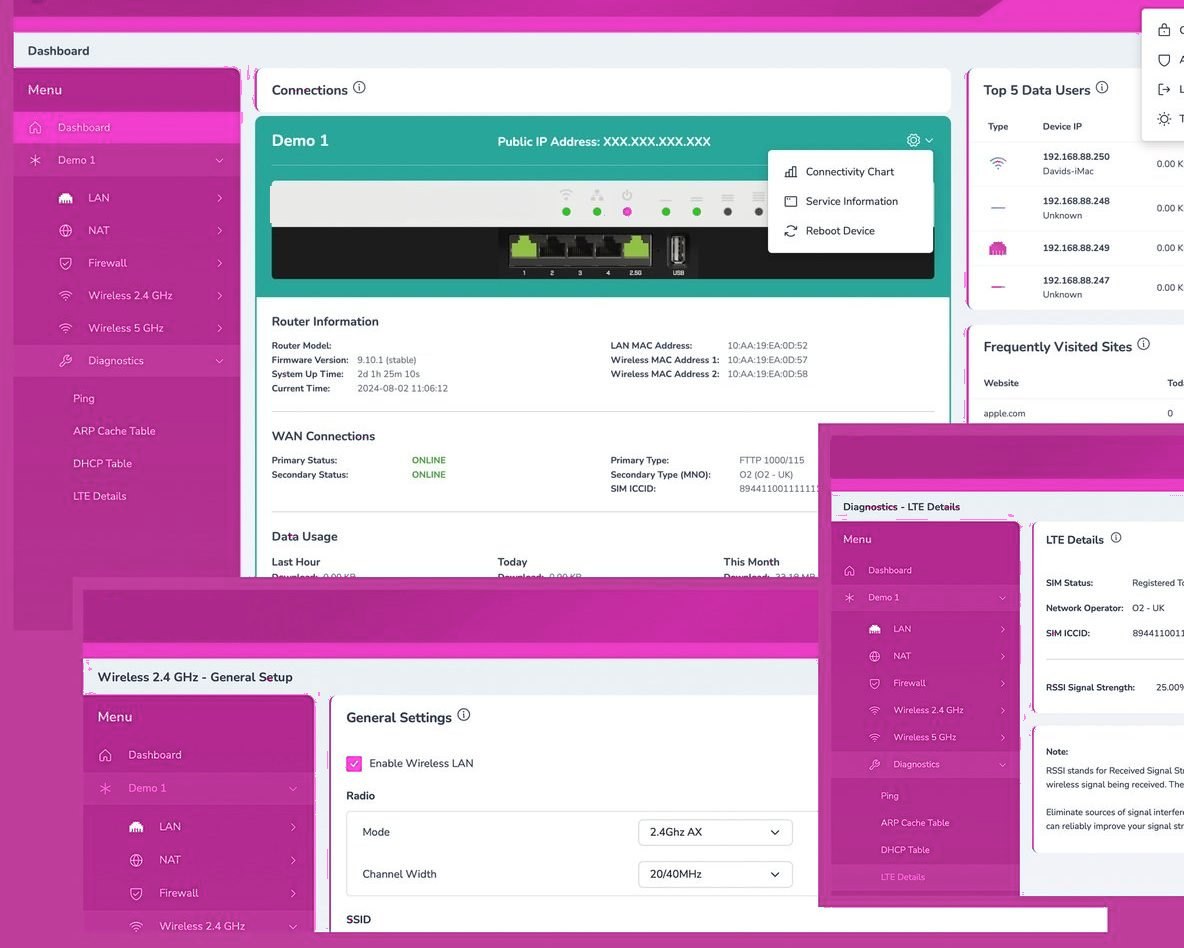
Fibre to the building, managed to the desk.
Full fibre (FTTP) runs fibre all the way into your premises over the Openreach or CityFibre network. Telexico supplies the managed router, checks what each carrier can deliver at your postcode and keeps it monitored.
Need the same speed up as down, guaranteed? That is a dedicated leased line, on the next page of the range.
What we hear every week.
The frustrations behind why businesses search for business broadband contract renewal in the first place. If any of these feel familiar, the fix is straightforward.
Auto-renewal letters arriving at higher prices
Incumbent provider sends a renewal letter — often at notably higher monthly rates than your current contract. Most UK businesses miss the window to challenge and end up paying significantly more for the same service.
Notice period traps
Most UK business broadband contracts require 30-90 days' written notice to terminate. Miss the window and you auto-renew on the new terms — typically 12-36 months on higher rates.
No visibility on what's now available
Two or three years on from your original contract, the market has moved. FTTP coverage has expanded, CityFibre has built in new areas, prices have shifted. Most UK businesses don't know what's actually available now.
Loyalty often costs more than switching
Counterintuitively, staying with the same provider often costs more long-term than switching. Renewal pricing rarely matches new-customer acquisition pricing. The provider banks on inertia.
Three honest options at UK broadband contract renewal
**Option 1 — Auto-renew as offered.** Path of least resistance. Often the worst commercial outcome — renewal rates are typically higher than fair-market. Suits operations where avoiding any disruption strongly outweighs cost. **Option 2 — Negotiate with your incumbent.** Most UK providers will reduce price when challenged with a competitive quote. Call retention, mention you're considering switching, ask for new-customer pricing. Works often but not always; depends on the provider and the contract value. **Option 3 — Switch to a better-fit provider.** If the incumbent's commercials aren't competitive, or the service has been frustrating, or your operation has outgrown what they deliver — switching is the right answer. Modern UK business broadband providers handle migration cleanly with parallel running and scheduled cutover, so disruption is minimal. **The honest test:** if your current contract has been broadly working and the renewal pricing is reasonable when challenged, stay. If you've been frustrated and/or the renewal pricing is significantly above market, switch. Most UK SMEs end up doing one or the other rather than auto-renewing as offered.
Built to stay up.
- Full fibre, SoGEA or a leased line, chosen from the survey
- Automatic 4G/5G failover available on every business set-up
- Monitored from the Telexico portal, supported by a named UK engineer
The Telexico approach to business broadband contract renewal.
Six things our customers consistently tell us matter.
Know your notice window before renewal date
Find your contract notice period (typically 30-90 days) and the renewal date. Diary the date you need to act by — earlier than the renewal itself.
Check what's actually available now
FTTP coverage, CityFibre availability, altnet expansion — the UK market has moved. Whatever your address looked like 2-3 years ago, it may be different now.
Get a competitive quote before negotiating
Incumbent retention teams respond to specific competitive quotes. Vague 'I might switch' carries less weight than 'I've been quoted £X with provider Y'.
Negotiate from a position of options
Quote in hand, you can either: agree better terms with incumbent and stay (often works), or proceed with switch and avoid the auto-renewal trap entirely.
Switch cleanly if that's the call
Modern UK broadband migration is project-managed with parallel running. Disruption is minimal — usually a brief out-of-hours cutover. The operational impact people fear rarely materialises.
Telexico free infrastructure review
Free review of your current setup, what you pay, what's available at your address, where switching would or wouldn't make sense. Honest assessment — sometimes the answer is 'stay where you are'.
How UK businesses actually decide at contract renewal
Most UK SMEs we work with go through a similar decision pattern. They get the renewal letter; it's higher than they expected; they ask for a competitive quote elsewhere; they go back to the incumbent with the quote; the incumbent matches or doesn't. If the incumbent matches and service has been broadly fine, they often stay (the operational simplicity of not switching has value). If the incumbent doesn't match, or the service has been frustrating, they switch. We help with any of those three outcomes — including being honest when staying with the incumbent is the right call.
How it works for businesses like yours.
Three real-world setups we deliver across the UK.
Small office on FTTC nearing contract end
Original contract on FTTC; PSTN switch-off coming; FTTP now available at the address. Natural moment to upgrade and switch rather than auto-renew on legacy product.
Hospitality with EPOS dependency on broadband
Restaurant or retail where broadband downtime stops card payments. Contract renewal is the moment to add proper failover plus reconsider primary connectivity.
Growing SME on multi-provider stack
Office that's grown across multiple providers (broadband from one, phones from another, WiFi from a third). Contract end is the natural consolidation moment.
Why UK businesses use Telexico for contract renewal decisions
Telexico does free no-obligation infrastructure reviews including honest commercial assessment. We tell you when switching to Telexico makes sense, and when it doesn't — staying with your incumbent on negotiated better terms is sometimes the right answer. UK provider, Wolverhampton-headquartered, transparent commercials.
What you actually get from Telexico.
Honest about scope. No aggressive sales tactics, no surprise renewal jumps, no tier-1 call-centre triage. Real UK engineers, transparent pricing, one provider relationship across the stack.
UK-based provider
Wolverhampton-headquartered. Engineers cover the West Midlands daily; UK-wide install via our partner network. Real UK engineer support, UK data residency, UK contractual relationship — not US-routed SaaS.
Real engineer support
When you call Telexico, you reach someone who can actually fix things. Response SLA backed by real engineering capacity rather than call-centre headcount. Named account manager for ongoing customers.
Free infrastructure review
Every engagement starts with a no-obligation audit of your current setup. Honest recommendation — sometimes that's "stay with your current provider after negotiation." We'd rather be honest than oversell.
Transparent pricing
What you sign for is what you pay — including renewal. No teaser pricing that jumps 30-100% at year two. No mid-contract CPI shock. Predictable multi-year cost from day one.
One provider, one platform
Broadband, hosted VoIP, business WiFi, AI Receptionist, 4G/5G failover, CCTV consolidated onto one Telexico relationship. Single bill, single support number, single engineer when something needs attention.
Migration project-managed
Switching to Telexico isn't DIY. We handle contract audit, notice timing, ordering, parallel running, cutover, old-provider close-out. Customer-visible disruption typically measured in minutes.
Tailored around your business.
Tell us what you have now and what's frustrating you. We'll come back with a tailored review of where we can simplify, consolidate or improve it — no fixed-package pressure, no hard sell.
You may also want to read
What is Starlink for business
Starlink Business is SpaceX's commercial-grade satellite internet service for businesses. It uses a constellation of...
Leased line vs full fibre
Full fibre (FTTP) and leased lines are both fibre-optic business connectivity, but they're fundamentally different...
Openreach vs CityFibre
Most UK business broadband is delivered over one of two main fibre networks: Openreach (BT-owned, the incumbent, covers...
Business Broadband cost
Indicative UK pricing for business broadband — what affects the price, ranges, and a free tailored review.
Leased Lines cost
Indicative UK pricing for leased lines — what affects the price, ranges, and a free tailored review.
Free infrastructure review
Send us your current setup. We'll review what you have, what you pay, and where we can simplify.
Fibre that stays up.
Frequently asked questions
When should I start looking at renewal options?
60-90 days before contract end. This gives time to: check your specific contract notice period (usually 30-90 days written notice to terminate), get competitive quotes, negotiate with incumbent, and either renew on better terms or organise a clean switch. Starting earlier is fine; starting later risks auto-renewal you didn't intend.
Will my current provider actually offer better terms if I challenge them?
Often yes — UK retention teams have meaningful pricing flexibility, especially for established customers. The reduction varies (10-30% off renewal pricing is common when armed with competitive quotes); some providers are more flexible than others. Worth the conversation regardless.
What does switching actually involve operationally?
Project-managed migration: new provider installs replacement service (typical 2-6 weeks lead time); parallel running where service overlaps; scheduled out-of-hours cutover; old service ceased. Most UK businesses experience minimal operational disruption — usually a brief cutover window scheduled around the operation.
Can I keep my static IP or specific configurations?
Static IPs typically don't transfer between providers (each provider issues their own IP ranges). Switching means a new IP — which affects firewalls, VPNs, hosted services pointing to your old IP. Manageable but requires planning. Other configurations (router setup, port forwarding, custom DNS) need to be reconfigured on new provider's equipment.
What if my incumbent's renewal pricing is actually fair?
Then staying is the right call. Honest answer: not every contract renewal needs to result in a switch. If the current provider's service has been broadly fine and the renewal pricing is competitive when challenged, the operational simplicity of staying has real value. We're honest about this during free infrastructure reviews.
What about phone systems renewing at the same time?
Often a coordinated review makes sense — broadband renewal is a natural moment to also review phones, WiFi and AI. Many UK SMEs consolidate at contract renewal because the timing aligns. We scope the full picture during free infrastructure reviews and recommend coordinated or phased approach as appropriate.
How does Telexico's free infrastructure review work?
Send us your current setup (provider, contract details, what's working, what's frustrating). We review your current contract terms, check what's available at your address, run a commercial comparison, and give you an honest recommendation. No obligation; no high-pressure follow-up. Sometimes the recommendation is 'stay where you are on negotiated better terms' — which we'll say if that's accurate.
Apply this to your business?
Reading the guide is one thing; applying it to your specific operation is another. Send us your current setup — we'll review what you have, what fits, and where to start. No hard sell, no fixed-package pressure.